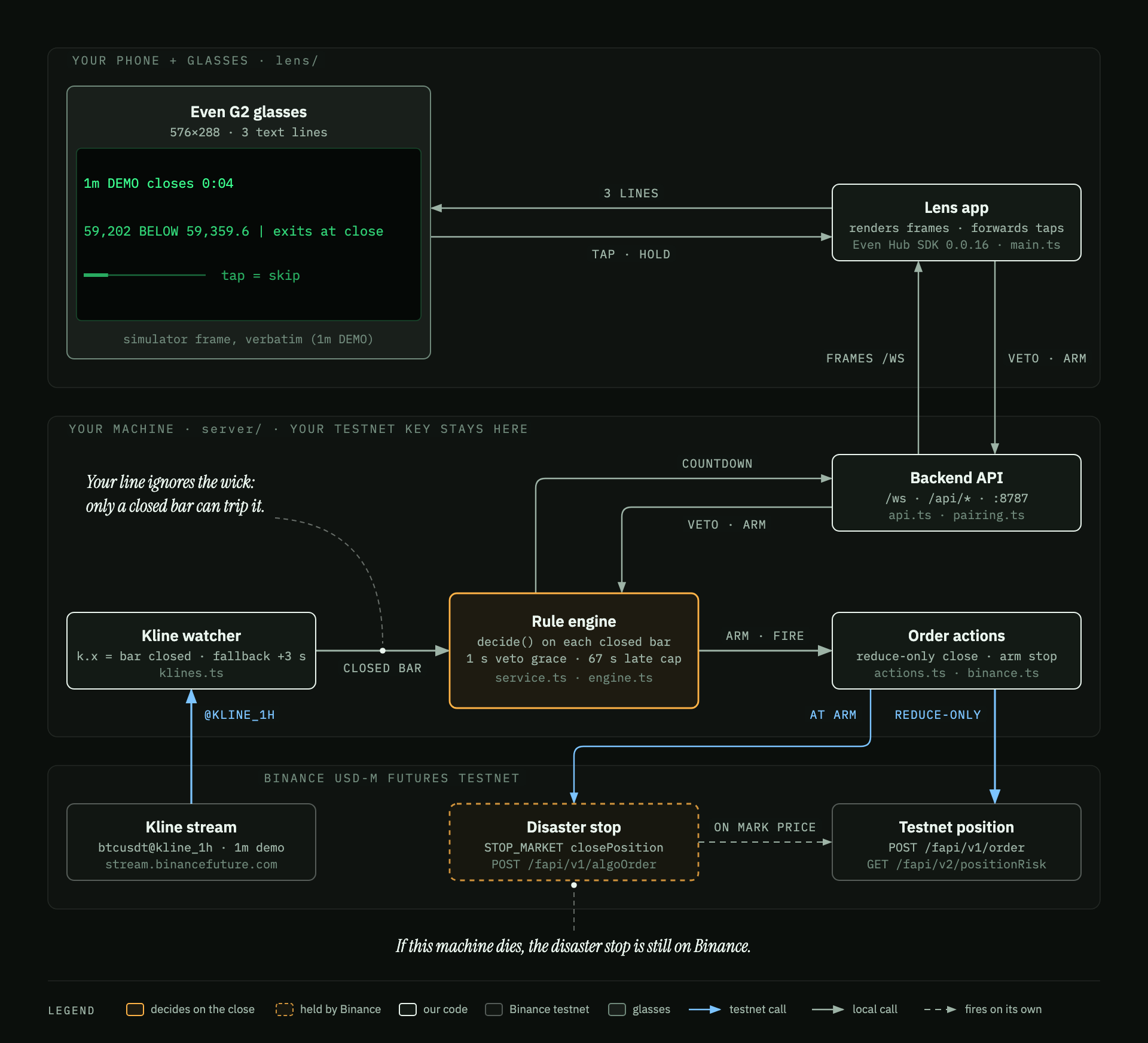
Three places, one job each. The glasses show the countdown and take one tap. A backend on your machine,
holding your testnet key, decides at the candle close. Binance Futures testnet keeps a disaster stop resting underneath, placed at arm and independent of both.
The watcher subscribes to btcusdt@kline_1h on the testnet stream; a message with k.x set is a closed bar.
No k.x 3 s after the boundary: it reads the last trade before the boundary over REST and accepts it when two consecutive reads agree.
decide() waits out the 1 s veto grace; a close past your line writes the intent to disk (server/.data/state.json by default),
then sends a reduce-only MARKET close; a reply without a fill price is read back by client order id.
2 · The lens and the veto
The lens holds no rule and no countdown clock. The server pushes a frame over /ws whenever the visible second or phase changes; the lens draws three text lines and forwards gestures.
One tap skips this close only (sent on the WebSocket, REST as fallback); a long press arms. A close decided more than 67 s after the boundary
is reported, never sent.
3 · The safety net
At arm, a STOP_MARKET closePosition stop goes to Binance (testnet refuses the classic endpoint with -4120, so it lands on
/fapi/v1/algoOrder). It is set to trigger on mark price and rests on Binance, so it does not depend on this machine. After a close it is cancelled only once the position reads flat; disarm removes it.
The order client refuses any REST host but testnet.binancefuture.com.
Testnet only · reduce-only · not financial advice · no custody. Your key stays on your machine (~/.config/binance/testnet.env by default);
the lens pairs with a single-use 6-digit code. Every box of ours names its source file (code at ee42eec). Run in the Even Hub simulator; no G2 hardware was used.